Strength through the full range: Isokinetic mode
Isokinetic mode fixes the cable speed. Push harder and resistance rises; ease off and it drops (Beyond Power). That makes it a tool for:
I'm a Beyond Power affiliate. If you buy a Voltra with my link or code TISSUEGUY, I may earn a commission at no extra cost to you. Everything in this guide comes from my own training and programming with the unit.
- Testing how much strength you have, and whether you can hold it through the entire range of a movement.
- Max-effort contractions without ballistic risk. You can push as hard as you want and the cable still won't go faster than the set speed.
- Stability and balance under high force. You learn to stay organized while producing a lot of force.
- Neurological complexity and efficiency, when the focus is on the concentric.
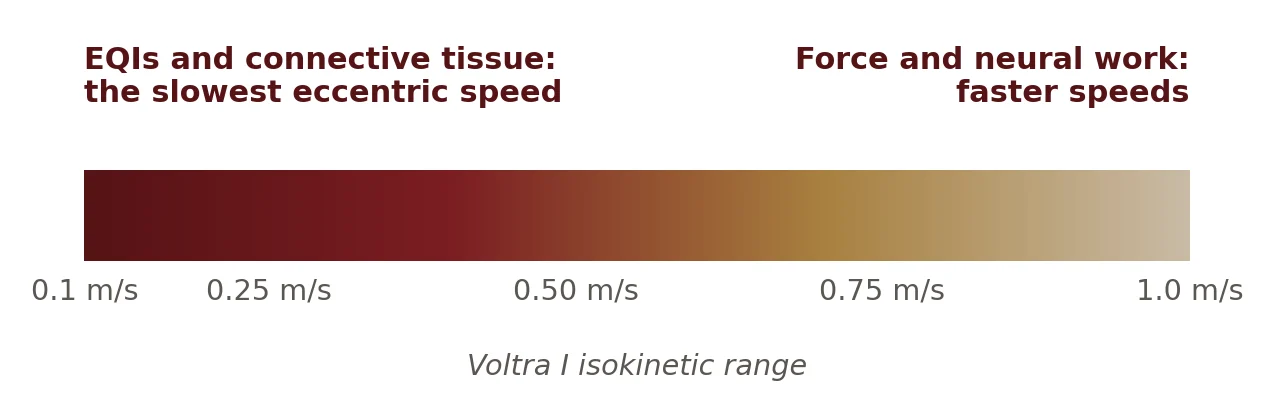
Speed: for connective tissue and EQIs, use the slowest eccentric speed available. For force output and neural development, the speed can go higher. The Voltra I's isokinetic range runs from 0.1 to 1.0 m/s (Beyond Power). EQIs live at the bottom of that range; faster force and neural work moves up toward the top.